There are few better moments in racquet sports than walking off the court after losing 6-4, 7-5.
It sounds absurd. We spend our lives trying to win, yet ask any lifelong tennis or pickleball player about the matches they remember most and very few will begin with the score. They’ll talk about the twenty-ball rally that neither player should have survived. The opponent who exposed a weakness they didn’t know they had. The doubles partner who somehow seemed to know where the next ball was going before anyone else did.
The best matches leave you exhausted. They also leave you better.
We’ve all played someone who was so much stronger that every point felt hopeless. We’ve also played someone we could beat almost effortlessly, leaving with a win but very little satisfaction. Neither experience teaches us much. The matches that stay with us are the ones where we have to solve problems, adjust our tactics, and discover shots we weren’t sure we possessed.
Of course, skill level is only part of the equation.
Anyone who has played doubles for more than a few weekends knows that ratings don’t tell the whole story. Some players attack relentlessly. Others quietly construct points with patience. Some communicate every point; others let their racquets do the talking. One player thrives in chaos. Another creates calm.
The best doubles teams aren’t built from identical players. They’re built from complementary ones.
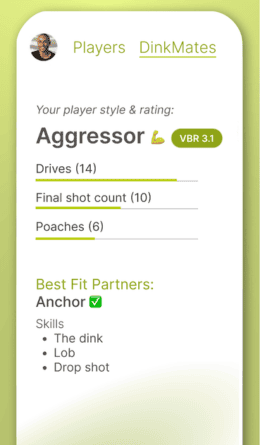
Pickleball offers a perfect example. One partner may naturally play the aggressor, looking to speed up every ball. The other may thrive as the steady anchor, absorbing pressure, resetting points, and waiting for the right opportunity. Individually they’re good players. Together they become something better.
The same is true in tennis. An attacking all-court player often flourishes alongside a consistent baseliner. A big server benefits from a partner with exceptional anticipation at the net. Chemistry isn’t accidental. It’s tactical.
Yet for all the attention players devote to finding the right racquet, the perfect string tension, or the latest paddle, we spend remarkably little time thinking about the variable that may influence our enjoyment and improvement more than any other: finding the right people to play with.
That’s beginning to change.
That’s one of the reasons we’re excited to partner with Hitch. Rather than reducing players to a simple rating, Hitch recognizes that compatibility is far more nuanced than a number.
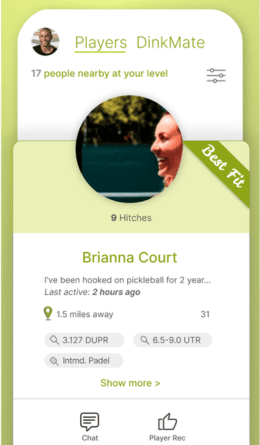
Through its Best Fit Player Card, players can showcase photos, videos, and a bit of their personality, making it easier to find partners they’ll genuinely enjoy sharing a court with. Its AI-powered video analysis goes a step further, evaluating both skill level and playing style to identify whether a player naturally leans toward aggression, consistency, or somewhere in between. The result is better pairings, more competitive matches, and ultimately, more enjoyable time on court.
That’s why the partnership between Hitch and CourtsApp feels so natural.
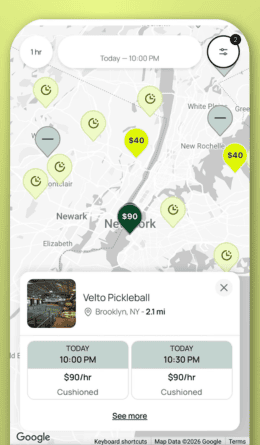
Hitch helps players find opponents and partners who challenge them, complement their style, and bring out their best tennis or pickleball. CourtsApp makes it easy to find and book the court where those matches happen.
Together, we’re removing two of the biggest barriers to playing more often: finding the right people and finding the right place to play.
Because every memorable match begins long before the first serve. It begins with the right opponent.